
Infineon BF771E6327: Key Specifications and Application Circuit Design
The Infineon BF771E6327 is a high-performance N-channel enhancement mode Vertical Junction Field Effect Transistor (VJFET) designed primarily for RF and microwave applications. Its unique architecture, leveraging silicon carbide (SiC) technology, provides significant advantages in high-frequency, high-temperature, and high-efficiency scenarios where traditional silicon-based transistors fall short. This article delves into its key specifications and provides a foundational guide for its application circuit design.
Key Specifications
The BF771E6327 is characterized by its exceptional electrical properties, making it a standout component for demanding RF tasks.
Technology: Built on a silicon carbide (SiC) substrate, the device offers superior thermal conductivity, high breakdown voltage, and excellent high-temperature stability compared to its silicon counterparts.
Drain-Source Voltage (VDS): It features a high breakdown voltage of 120 V, providing a wide dynamic range and robust operation in circuits prone to voltage spikes.
Continuous Drain Current (ID): The device can handle a continuous drain current of 150 mA, suitable for medium-power RF amplification stages.
Power Output: It is capable of delivering 3.5 W of typical output power at 1 GHz, making it ideal for transmitters and power amplifiers in the UHF and microwave bands.
Gain and Efficiency: A key strength is its high power gain, typically around 14 dB at 1 GHz, coupled with good power-added efficiency (PAE). This ensures strong signal amplification with minimal energy loss.
Low Noise Figure: While optimized for power, it also maintains a low noise figure, making it versatile for both transmitting and sensitive receiving front-ends.
Thermal Performance: The SiC construction allows for operation at channel temperatures up to 200 °C, enhancing reliability and reducing cooling requirements.
Application Circuit Design: A Basic RF Power Amplifier
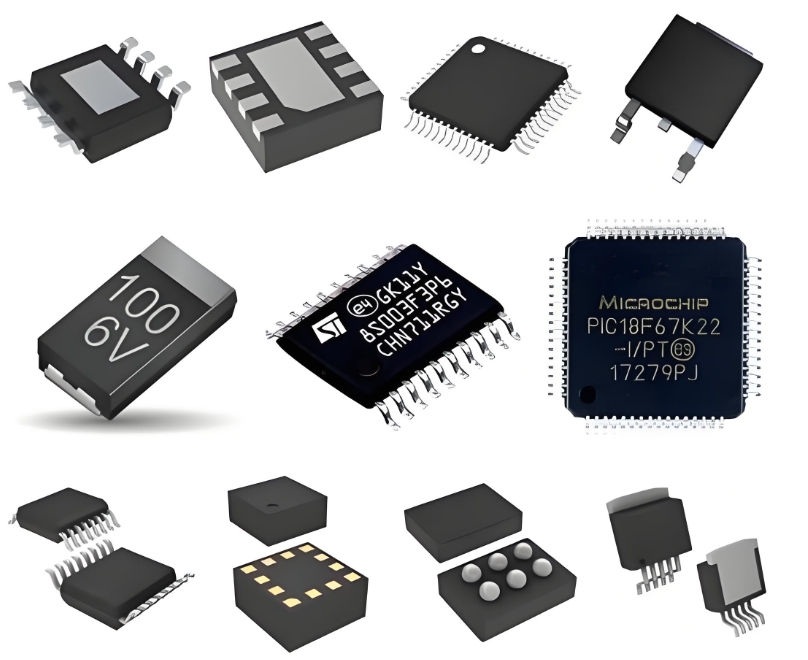
A primary application for the BF771E6327 is in Class A or AB linear RF power amplifiers for communication systems. Designing a stable and efficient circuit requires careful attention to biasing and impedance matching.
1. Biasing Network:
The VJFET is a normally-on device. A critical design aspect is providing a proper negative gate bias voltage to set the correct quiescent point (Q-point). A stable voltage source, often regulated by a low-dropout regulator (LDO) and a negative charge pump, is required to supply approximately -3.5 V to the gate. A current-limiting resistor and an RF choke (RFC) are essential to isolate the sensitive bias supply from the RF signal path while allowing the DC bias to reach the gate.
2. Impedance Matching:
For maximum power transfer, the input and output impedances of the transistor must be matched to the source (e.g., 50 Ω from a preceding stage) and the load (e.g., a 50 Ω antenna), respectively. This is achieved using impedance matching networks typically composed of microstrip lines, capacitors, and inductors. These networks are designed using Smith chart techniques or simulation software (like ADS or SPICE) based on the S-parameters (S11, S22) provided in the datasheet. Proper matching ensures optimal gain, efficiency, and stability.
3. Stability Considerations:
To prevent unwanted oscillations, the circuit must be unconditionally stable. This involves adding series resistors or ferrite beads in the gate and drain bias lines. Additionally, careful PCB layout is paramount: grounding vias should be placed very close to the source leads to minimize parasitic inductance, and the RF paths should be kept short and direct.
4. Thermal Management:
Despite its high-temperature tolerance, efficient heat dissipation is crucial for long-term reliability and performance. The BF771E6327 should be mounted on a thermally conductive PCB with a large copper pour area connected to the drain pad. For higher power dissipation, a dedicated heatsink is recommended to keep the junction temperature within safe limits.
A simplified application diagram would show the transistor with a negative gate bias network, DC-blocking capacitors at the input/output, RF chokes on the bias lines, and microstrip matching networks connected to the input and output ports.
ICGOODFIND Summary
The Infineon BF771E6327 SiC VJFET is a robust and high-performance solution for RF power amplification, excelling in environments that demand high frequency, high power, and exceptional thermal stability. Its design requires careful attention to negative gate biasing and precise impedance matching to fully leverage its capabilities in applications ranging from commercial radio to aerospace and defense systems.
Keywords: Silicon Carbide (SiC), RF Power Amplifier, VJFET, Impedance Matching, Negative Gate Bias.

